
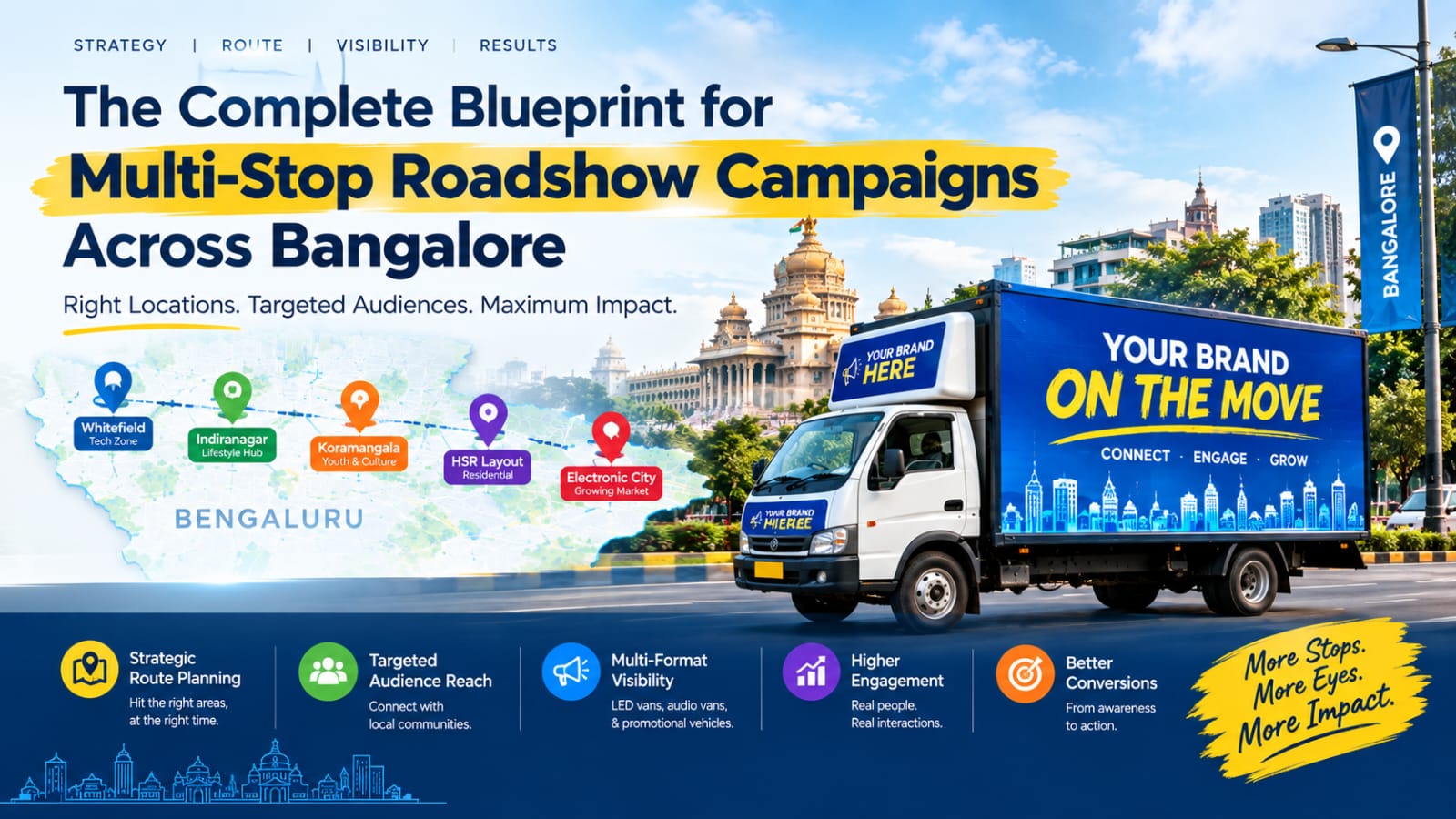
The Complete Blueprint for Multi-Stop Roadshow Campaigns Across Bangalore
The Power of Experiential Mobility: Beyond Passive Advertising
Passive advertising delivers messages, but experiential marketing creates relationships. In an age dominated by digital ad blockers, fast-forwarded commercials, and visual saturation along major urban corridors, consumers crave direct, tactile interactions before making high-consideration purchasing decisions. Merely seeing an image of a new product is rarely enough to drive immediate conversion; consumers want to touch it, sample it, test its features, and ask direct questions.
This is where a strategically executed roadshow transforms traditional marketing. Instead of waiting for prospective customers to visit a brick-and-mortar storefront or stumble upon an e-commerce landing page, an experiential roadshow brings the entire brand experience directly to corporate tech parks, residential gated communities, college campuses, and bustling commercial high streets.
When paired with modern mobile Van Advertising Bangalore, an activation becomes an agile, self-contained pop-up activation on wheels. It eliminates the friction of permanent site leases, bypasses mall activation space limitations, and delivers dynamic street-level Branding that captures both moving transit eyeballs and deep on-ground consumer engagement.
Deconstructing the Anatomy of an Experiential Roadshow Vehicle
A successful roadshow depends on robust vehicle fabrication. Standard cargo trucks cannot merely be wrapped in printed stickers; they must be engineered into functional, engaging, and compliant brand pavilions capable of rapid deployment and teardown.
+-----------------------------------------------------------------------------+
|             CUSTOM ROADSHOW VEHICLE: MECHANICAL & INTERIOR LAYOUT           |
+-----------------------------------------------------------------------------+
|                                                                             |
|      +---------------------------------------------------------------+      |
|      |  Hydraulic Gull-Wing Stage / Canopy Extension                 |      |
|      |  - 180-degree pneumatic side lift creating covered promo zone |      |
|      +---------------------------------------------------------------+      |
|      |  Interior Experiential & Demonstration Bay                    |      |
|      |  - Product display shelves, live demo kiosks, touch displays  |      |
|      |  - Secured inventory lockboxes for samples and merchandise    |      |
|      +---------------------------------------------------------------+      |
|      |  AV & On-Ground Activation Hardware                           |      |
|      |  - High-decibel wireless PA system & professional wireless mic|      |
|      |  - Integrated LED backwall or dual high-bright LCD screens     |      |
|      +---------------------------------------------------------------+      |
|      |  Autonomous Utility Compartment                               |      |
|      |  - 5 kVA silent acoustic diesel genset with AVR stabilization  |      |
|      |  - Heavy-duty leveling stabilizer jacks for uneven terrain    |      |
|      +---------------------------------------------------------------+      |
|                                                                             |
+-----------------------------------------------------------------------------+
1. The Hydraulic Gull-Wing Stage
The core of an interactive roadshow vehicle is its side-opening architecture. Using heavy-duty pneumatic struts or hydraulic lifts, the side panels lift upward to create an overhead weather canopy, while the lower body unfolds into an elevated presentation stage. This setup allows brand emcees to host trivia games, demonstrate appliances, run live product sampling, or unveil new tech devices without requiring external tents or platforms.
2. Product Demonstration & Sampling Counters
The interior payload bay is custom-fitted according to campaign objectives. For FMCG and beverage brands, it includes certified food-grade stainless steel counters, temperature-controlled mini-chillers, and sanitary disposal points. For electronics and fintech brands, the space features anti-theft tethered demo pedestals, high-speed Wi-Fi hotspots, and interactive touchscreens running custom app experiences.
3. Integrated Audio-Visual and Power Independence
Roadshows require complete power autonomy. Vehicles carry an onboard, vibration-isolated silent generator delivering steady power to commercial-grade display screens, exterior lighting rigs, and PA systems. The entire vehicle operates independently of external building power grids, allowing pop-up stops in open parking zones, public grounds, or vacant lots.
Route Selection: Conquering Bengaluru’s Micro-Markets
Bangalore is not a single, homogeneous market; it is an archipelago of specialized micro-economies. A roadshow route strategy that excels in the tech corridors of Whitefield will fail if applied without modification to the traditional commercial hubs of Malleshwaram or Jayanagar. High-ROI mobile Van Advertising demands micro-market audience calibration:
+-----------------------------------------------------------------------------+
|                     BENGALURU ROADSHOW ROUTE CORRIDORS                      |
+-----------------------------------------------------------------------------+
|                                                                             |
|   [Tech Parks & SEZs]       --> High-income tech workforce; fintech, auto,  |
|   (ORR, Whitefield, E-City)     premium lifestyle, and SaaS solutions       |
|            |                                                                |
|            v                                                                |
|   [Modern Residential Hubs] --> Affluent young families; FMCG, edtech, home |
|   (HSR, Sarjapur, Hebbal)       automation, and healthcare activations      |
|            |                                                                |
|            v                                                                |
|   [Traditional High Streets]--> High-density retail crowds; value retail,   |
|   (Jayanagar, Malleshwaram)     apparel, gold jewelry, and consumer banking |
|                                                                             |
+-----------------------------------------------------------------------------+
Corridor A: Tech Parks & IT Corridors (Whitefield, Bellandur, Electronic City)
Target Audience: Tech professionals, mid-to-senior corporate executives, and dual-income households.
Optimal Activation Times: 12:00 PM – 3:00 PM (lunchtime campus footfall) and 5:30 PM – 8:00 PM (evening departures).
Best Categories: Automobile test drives, fintech apps, co-living/real estate developments, consumer electronics, and premium credit products.
Corridor B: High-Density Residential Belts (HSR Layout, Sarjapur Road, Sahakara Nagar)
Target Audience: Young families, homeowners, and children.
Optimal Activation Times: Saturday and Sunday mornings (8:30 AM – 11:30 AM) and weekend evenings (5:00 PM – 9:00 PM).
Best Categories: Packaged consumer goods, high-speed broadband connections, edtech platforms, home interior services, and health insurance.
Corridor C: Traditional Commercial Epicenters (Jayanagar, Gandhi Bazaar, Malleshwaram)
Target Audience: Multi-generational families, traditional business owners, and senior shoppers.
Optimal Activation Times: Daily evening shopping hours (4:30 PM – 8:30 PM).
Best Categories: Consumer banking, regional retail brand launches, consumer durables, and local healthcare services.
On-Ground Human Capital: The Emcee, Promoters, and Brand Custodians
A state-of-the-art vehicle provides the stage, but the on-ground human team delivers the conversions. Without well-trained promoters, even the most elaborate mobile stage becomes passive scenery. A complete roadshow deployment relies on clear human roles:
| Role | Core Responsibilities | Key Performance Indicator (KPI) |
| Professional Emcee | Manages stage games, engages crowds using the PA system, and drives active participation. | Hourly crowd draw and footfall retention time |
| Brand Promoters | Distribute product samples, hand out brochures, and manage product demo stations. | Samples distributed and individual demos completed |
| Lead Capture Specialists | Collect verified phone numbers, app downloads, and survey responses via digital tablets. | Total qualified leads captured (MQLs) |
| Route / Logistics Marshal | Manages parking permissions, route timing, generator upkeep, and crowd safety. | On-time route schedule and zero site-safety incidents |
Every promoter must undergo extensive brand immersion before deployment. They must speak the local language fluently (Kannada) alongside English and Hindi, understand product specifications thoroughly, and handle customer queries politely while maintaining brand integrity under street-level pressure.
Operational Roadmap: Lead Times, Logistics, and BBMP Compliance
Executing a multi-week promotional tour across Karnataka’s capital requires detailed logistical preparation. Attempting to cut corners on civic permissions or vehicle mechanics risks impounded fleets, police fines, and negative PR.
+-----------------------------------------------------------------------------+
|                 6-WEEK ROADSHOW CAMPAIGN PREPARATION TIMELINE               |
+-----------------------------------------------------------------------------+
|                                                                             |
|  [WEEKS 1 - 2] Fabrication Blueprinting, RTO Filings & Creative Design     |
|       |                                                                     |
|       v                                                                     |
|  [WEEKS 3 - 4] Vehicle Body Fabrication, Audio/Display Setup, Printing      |
|       |                                                                     |
|       v                                                                     |
|  [WEEK 5]     BBMP Approvals, Traffic Police NOCs & Crew Training           |
|       |                                                                     |
|       v                                                                     |
|  [WEEK 6]     Dry-Run Route Testing & Full Multi-Zone Campaign Rollout      |
|                                                                             |
+-----------------------------------------------------------------------------+
Municipal Clearances & Traffic Police NOCs
Operating an active experiential vehicle with amplified sound requires dedicated permits. Campaign teams must coordinate:
BBMP Advertisement Department Clearances: Securing official transit display sanction letters.
Bangalore Traffic Police (BTP) NOC: Filing route plans to guarantee vehicles do not obstruct traffic flow during peak hours or park in prohibited “No Parking” zones.
Private Tech Park & Gated Society Approvals: Securing estate management access permissions, vendor gate passes, and electrical fire safety clearance certificates for private campus activations.
Measuring Experiential ROI: Turning Footfall into Hard Data
Unlike static hoardings, an experiential roadshow provides rich, trackable quantitative data:
Direct Sample-to-Conversion Tracking: Assign unique coupon codes to product samples. When consumers redeem the promo code online or in local retail stores, point-of-sale systems tie the revenue directly to the specific roadshow date and neighborhood.
On-Ground Lead Capture: Promoters armed with mobile CRM apps capture validated phone numbers (via instant OTP) in exchange for brand gifts or contest entries.
Footfall Geofencing Analysis: By setting up virtual perimeter geofences around scheduled van stops, brands can track how many mobile devices exposed to the roadshow later visit nearby retail stores or showrooms over the following 14 days.
Frequently Asked Questions (FAQ)
How many stops can an experiential roadshow make in a single day?
A standard roadshow schedule typically executes 3 to 5 high-impact stops per day. Each activation stop lasts between 60 to 90 minutes, providing enough time to build crowd interest, run interactive demonstrations, capture leads, and repack the vehicle safely before moving to the next scheduled neighborhood hub.
Can custom stages be built onto smaller vehicles like the Tata Ace?
Yes. Smaller chassis like the Tata Ace or Mahindra Bolero Maxi Truck are ideal for narrow neighborhood streets and dense residential societies. For large corporate activations or major product launches requiring full performance stages and expansive display walls, larger platforms like the Ashok Leyland Ecomet, BharatBenz, or 14-foot truck chassis provide the necessary footprint.
How are sound restrictions managed in residential and commercial areas?
All sound operations are managed using directional audio systems, ensuring sound travels toward the audience immediately in front of the vehicle rather than spilling out broadly. Amplified emcee activities strictly observe municipal quiet hours (all PA systems are powered down by 10:00 PM) and are fully muted when passing hospitals, educational institutions, and designated silent zones.
What contingency plans exist for sudden vehicle breakdowns or rain?
Professional campaign management includes dedicated backup generator circuits, full weather-resistant canopy covers for on-ground demo areas, and standby maintenance support to keep your activation running smoothly regardless of weather conditions.