
Day-to-Night Impact: Why LED Van Advertising Outperforms Traditional Billboards in Bengaluru
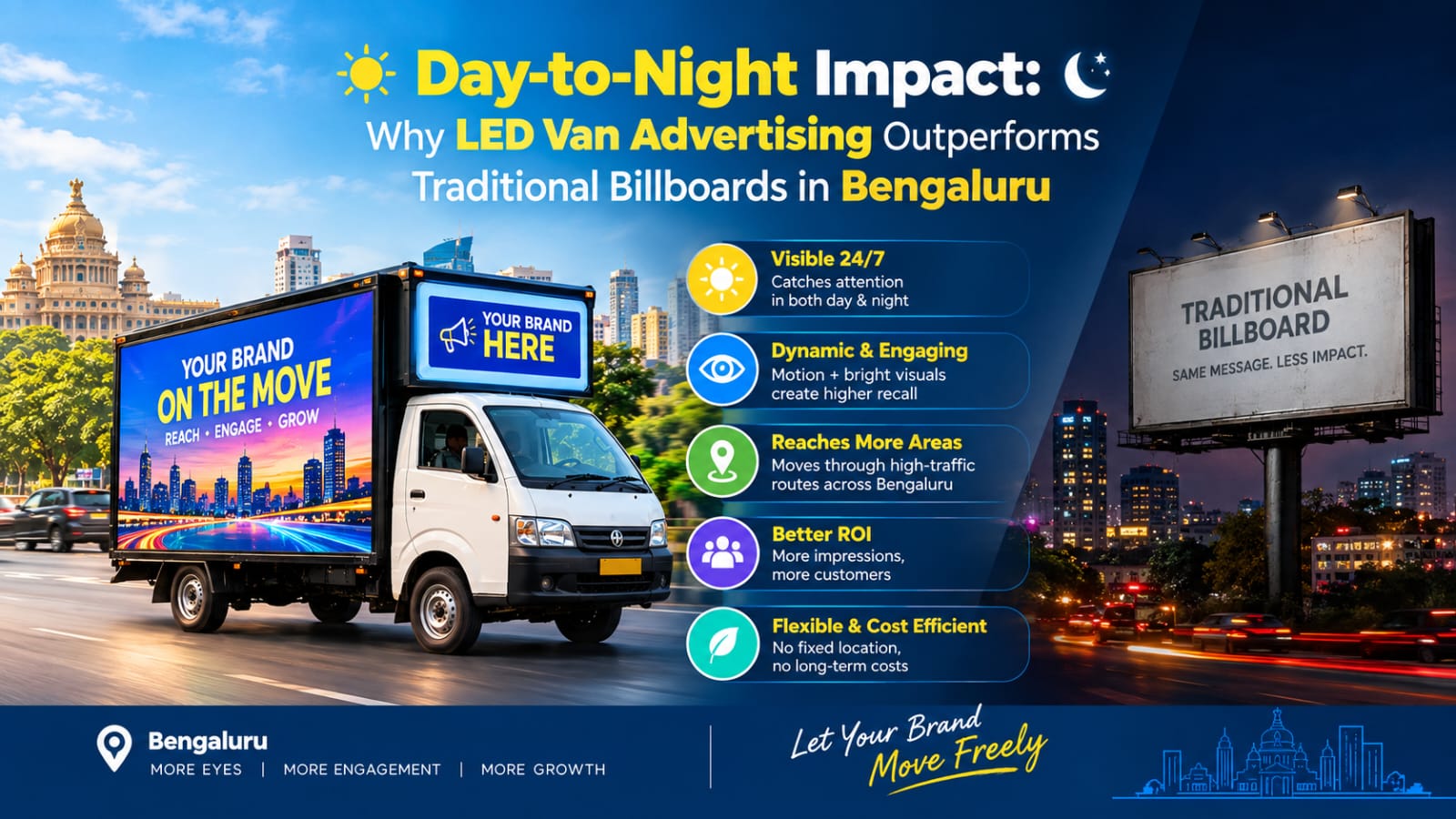
The Digital Evolution of Out-of-Home Media
Static outdoor hoardings face an uphill battle against consumer distraction. Pedestrians, commuters, and vehicle passengers navigate busy urban corridors while glued to mobile screens, developing an instinctive blindness to static, unmoving print posters. To capture attention on today’s roads, out-of-home media must match the dynamic, motion-driven visual formats consumers consume online.
This behavioral reality has turned led van advertising into one of the fastest-growing channels for experiential out-of-home Branding. Rather than placing a static printed canvas along a distant skyline, LED digital display vehicles bring high-definition video, real-time promotional updates, and synchronized audio directly to street level.
For businesses looking for mobile Van Advertising near me that can turn heads in high-density markets, digital display trucks offer an agile, high-luminance canvas that operates with equal brilliance under bright midday sun and late-night city traffic. As traditional billboard costs rise alongside strict municipal hoardings restrictions, deploying tech-forward mobile Van Advertising Bangalore gives brands the mobility, flexibility, and visual dominance needed to win modern attention.
Technical Superiority: Comparing Static Flex vs. High-Definition LED Vans
The technical capabilities of high-bright digital vehicle panels go far beyond traditional flex-board mobile advertising. The following breakdown shows how digital transit displays compare against traditional static alternatives:
| Campaign Feature | Traditional Static Flex Van | High-Definition LED Display Van |
| Media Type | 2D Static Printed Vinyl Sheet | Full-Motion MP4 Video, Motion Graphics, Animations |
| Daylight Visibility | Dependent on external sunlight; prone to glare | High-nit SMD LED panels (up to 6,500 nits) readable in direct sunlight |
| Night Illumination | Backlit tube lights or perimeter spotlights | Self-illuminating screen with auto-dimming ambient light sensors |
| Creative Flexibility | Requires reprinting and manual re-mounting for changes | Instant digital creative updates via USB or cloud CMS |
| Multi-Message Support | Limited to a single creative during the campaign run | Can rotate multiple brand assets, offers, or product variants |
| Sensory Immersion | Visual only | High-definition video accompanied by external directional audio systems |
+-----------------------------------------------------------------------------+
|                 LED DISPLAY VAN ARCHITECTURE & HARDWARE LAYOUT              |
+-----------------------------------------------------------------------------+
|                                                                             |
|      +---------------------------------------------------------------+      |
|      |   P4/P5 Outdoor High-Luminance SMD LED Video Wall              |      |
|      |   - Brightness: 5,500 - 6,500 Nits | Auto-Luminance Dimming   |      |
|      |   - Resolution: True High-Definition Video Feed               |      |
|      +---------------------------------------------------------------+      |
|      |   Vibration-Damped Hydraulic Mounting Frame                   |      |
|      |   - Shock-absorbing brackets for uneven road surfaces         |      |
|      +---------------------------------------------------------------+      |
|      |   Power & Audio Engineering Bay                               |      |
|      |   - Enclosed Silent Commercial Diesel Genset (4-6 kVA)        |      |
|      |   - All-Weather Horn/Column Directional PA Sound System       |      |
|      |   - Cloud-Connected Industrial Media Player & GPS Module      |      |
|      +---------------------------------------------------------------+      |
|                                                                             |
+-----------------------------------------------------------------------------+
Unlocking Dayparting: Running Contextual Time-of-Day Campaigns
One of the sharpest advantages of running an LED display vehicle is dayparting—the ability to dynamically change your advertising creative based on the specific time of day, location, and audience mindset.
Traditional print banners lock a brand into a single visual message for weeks at a time. Digital transit media lets marketers run multi-segment schedules that align with consumer routines throughout a single operating day:
Morning Drive Window (8:00 AM – 11:30 AM)
Audience Mindset: Commuters heading to tech parks, corporate campuses, and co-working hubs.
Creative Strategy: High-contrast, easy-to-read static slides or slow-motion product teasers focusing on quick breakfasts, coffee deliveries, productivity apps, executive MBA programs, or newly launched residential projects near employment hubs.
Target Corridors: Major inbound arterial routes, including Outer Ring Road, Sarjapur Road, Whitefield main connectors, and Hebbal flyover approaches.
Midday Consumer Window (11:30 AM – 4:30 PM)
Audience Mindset: Neighborhood residents, homemakers, shoppers, and students moving through local retail and commercial corridors.
Creative Strategy: Engaging video demonstrations, app install promotions, discounts on consumer electronics, healthcare checkup packages, or quick-service restaurant lunch deals.
Target Corridors: High-density mixed-use sectors such as Indiranagar 100 Feet Road, Koramangala 80 Feet Road, Jayanagar 4th Block, and suburban neighborhood avenues.
Evening Rush & Leisure Window (5:00 PM – 10:00 PM)
Audience Mindset: Returning commuters, leisure shoppers, diners, and families out for evening entertainment.
Creative Strategy: High-energy video ads, cinematic lifestyle branding, entertainment events, fine dining showcases, and weekend shopping festivals. The LED display’s natural luminescence turns the vehicle into a standout visual attraction against dark streets.
Target Corridors: Commercial entertainment districts, restaurant strips, multiplex entry zones, and high-footfall transit hubs.
Navigating Bengaluru’s Complex Traffic & Route Optimization
Running a successful transit campaign across Bengaluru requires more than just mounting a screen on a truck and putting it in drive. The city’s unique traffic topography—characterized by narrow interior roadways, heavy peak-hour pinch points, and variable average vehicle speeds—demands a calculated route strategy.
Dwell-Time Maximization vs. Kilometers Covered
In typical transit advertising, businesses often measure success by total kilometers driven per day. In a dense metro environment like Bengaluru, raw mileage can be a misleading vanity metric. Driving 100 kilometers along an open expressway delivers far fewer meaningful impressions than covering 45 kilometers through stop-and-go commercial hubs.
LED transit vehicles achieve their highest return when moving through deliberate, low-speed circulation loops (between 10 and 20 km/h) near signals, crosswalks, and high-density commercial strips. Dwell time at major signals provides surrounding drivers and pedestrians 60 to 90 seconds of uninterrupted screen exposure—more than enough time to absorb a complete 30-second video message.
+-----------------------------------------------------------------------------+
|               STRATEGIC CIRCULATION & HIGH-DWELL TARGETING                  |
+-----------------------------------------------------------------------------+
|                                                                             |
|   [Arterial Tech Corridor]    --> High-traffic signals; extended idle time   |
|            |                                                                |
|            v                                                                |
|   [Commercial High Street]    --> Slow-speed evening cruise (10-15 km/h)    |
|            |                                                                |
|            v                                                                |
|   [Retail Mall / Multiplex]   --> Permitted static showcase during peaks    |
|                                                                             |
+-----------------------------------------------------------------------------+
Audio Engineering & Community-Sensitive Operations
While high-definition visuals do the heavy lifting, high-impact campaigns often integrate directional sound to maximize cut-through. However, outdoor audio must be managed responsibly to preserve brand sentiment and comply with civic sound ordinances.
Directional Column Speakers: Modern digital advertising vehicles use column-array directional speakers rather than omnidirectional public address cones. This focuses sound toward sidewalks and pedestrian walkways while minimizing harsh noise bleed into driver cabins or upper-floor residential balconies.
Noise Ordinance Compliance: Sound output is monitored and kept below municipal decibel thresholds (typically under 65 dB in commercial zones). Sound systems are automatically muted when moving through silent zones, hospital perimeters, and school areas.
Voice-Over & Jingle Synchronization: Video creative is paired with catchy, 10-to-15-second audio hooks rather than continuous spoken monologues. This makes messages easy to digest for pedestrians who only catch a brief passing snippet.
Measuring Performance & Verifying Campaign Execution
One common concern for brands investing in out-of-home media is campaign verification: Did the truck run the agreed routes? Was the screen operational for all 8 hours? Did target audiences actually see the creative?
Modern led van advertising addresses this with robust, automated telemetry and tracking systems:
Telematics & GPS Tracking: Every vehicle is fitted with tamper-proof, real-time GPS tracking. Marketing managers can access a client portal to monitor the vehicle’s exact speed, live location, route compliance, and ignition status throughout the day.
Automated Screen Playback Logs: Commercial media players record an unalterable, time-stamped proof-of-play log for every single video loop rendered on the screen.
Forward- and Rear-Facing Verification Cameras: Time-stamped dashcam photos taken at regular intervals provide physical proof of screen performance, ambient traffic density, and street-level conditions throughout the shift.
Direct Interaction Capture: By featuring dynamic QR codes, custom SMS short-codes, or dedicated promotional landing pages on the screen, marketing teams can directly attribute website traffic and lead volume to specific vehicle locations and operating hours.
Frequently Asked Questions (FAQ)
Can the LED screen display live video feeds or real-time event broadcasts?
Yes. Digital LED display vehicles come fitted with industrial media processors that support standard HDMI, SDI, and high-speed internet inputs. They can broadcast live sports events, corporate product launches, virtual keynotes, or interactive social media feeds directly to street audiences.
How are the screens powered, and does it affect the vehicle’s engine?
The LED screens and external sound systems run on a dedicated, silent commercial diesel generator (genset) housed inside an insulated utility compartment. The screen setup operates entirely independently of the vehicle’s engine and battery, ensuring steady voltage and preventing vehicle strain.
Can an LED advertising van operate safely during heavy monsoon rains?
Yes. Screens are built using outdoor-rated, IP65-certified waterproof LED modules with sealed silicon gaskets. The electronic driver cabinets and power supplies are housed in weatherproof, internally ventilated enclosures, allowing campaigns to run uninterrupted through heavy downpours.
How many times will my video ad play during a standard 8-hour shift?
In a typical rotation featuring a 30-second commercial spot on a 2-minute playback loop, your advertisement will play approximately 30 times per hour, translating to roughly 240 full broadcast plays over an 8-hour operating shift.