
Localized Out-of-Home: How to Find & Hire Reliable Mobile Van Advertising Near You
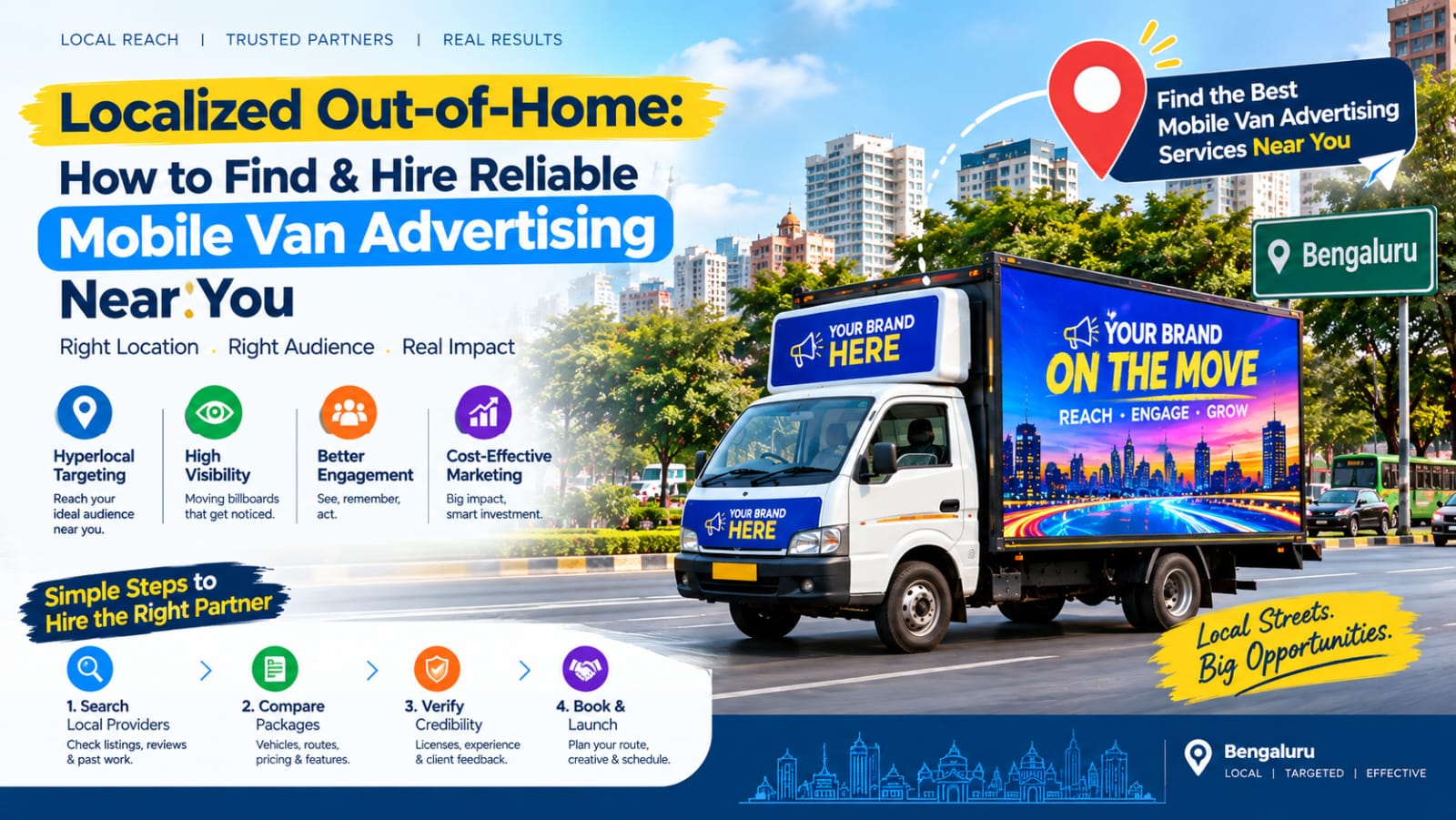
The Proximity Imperative: Why Local Businesses Win or Lose at the 5-Kilometer Border
For retail outlets, diagnostic centers, fitness clubs, multi-specialty clinics, regional supermarkets, and residential property developments, business success is rooted in physical geography. Studies of consumer behavior consistently reveal that upwards of 75% of non-discretionary household spending happens within a strict 3 to 5-kilometer radius of a consumer’s residence or workplace.
When business owners and regional marketing managers look for mobile Van Advertising near me, they are trying to solve a practical problem: How do you build immediate neighborhood presence without burning through marketing budget on broad, non-targeted city advertising?
Digital advertising platforms like Meta and Google often promise hyper-local geographic targeting, yet local businesses still experience ad spend waste. App users scroll past digital ads, algorithmic location targeting drifts beyond desired boundaries, and rising click costs make local customer acquisition expensive. High-impact mobile Van Advertising solves this by physically staking out the targeted neighborhood. Rather than waiting for a resident to open an app or drive past a distant highway hoarding, a dedicated transit display circulates directly through local streets, establishing physical familiarity and driving sustained Branding right where customers live.
The Catchment Saturation Framework: From Curiosity to Footfall
Executing a localized out-of-home campaign requires more than driving a branded vehicle aimlessly around local streets. Effective neighborhood transit media relies on a disciplined three-stage exposure model:
+-----------------------------------------------------------------------------+
|                 HYPERLOCAL CATCHMENT PENETRATION FUNNEL                     |
+-----------------------------------------------------------------------------+
|                                                                             |
|   [STAGE 1: MORNING EXIT PASS]                                              |
|   Route: Apartment gates, layout feeder junctions, community exits          |
|   Goal:  Capture commuters leaving home; establish brand name recall        |
|                                                                             |
|   [STAGE 2: MIDDAY HIGHWAY / COMMERCIAL SWEEP]                              |
|   Route: Local high streets, banks, clinics, grocery markets                |
|   Goal:  Reach local shoppers, homemakers, and mid-day footfall             |
|                                                                             |
|   [STAGE 3: EVENING RETENTION & CALL-TO-ACTION]                             |
|   Route: Standstill positioning outside retail zones & dinner hubs          |
|   Goal:  Drive immediate store visits with illuminated night visuals        |
|                                                                             |
+-----------------------------------------------------------------------------+
Stage 1: The Morning Exit Intercept
Between 8:00 AM and 10:30 AM, residential layouts experience high, predictable vehicle flow as residents head toward work, schools, and transit stops. Stationing or slow-cruising a branded advertising van at critical community egress points ensures your brand is the first message residents see as they begin their day.
Stage 2: Midday Commercial Core Circulation
Between 11:30 AM and 4:00 PM, suburban neighborhood avenues shift focus toward local shoppers, domestic decision-makers, and service visits. The transit van navigates interior layout avenues, commercial banking streets, and neighborhood retail markets at low speeds (15–20 km/h), maximizing visibility among shoppers making daily purchasing choices.
Stage 3: The Evening Destination Intercept
From 5:30 PM to 9:30 PM, community footfall peaks outside supermarkets, bakeries, dining strips, and pharmacies. During these hours, the vehicle shifts to approved, high-visibility static parking positions at busy commercial crossroads. Illuminated backlit panels or high-bright digital screens deliver an eye-level visual anchor that guides customers directly toward your physical doors.
Evaluating Local Vendors: A Field Checklist for Marketing Managers
Not all transit advertising operators provide the same standard of service. Cutting costs on unverified vendors often leads to unwashed trucks, off-duty drivers parked in remote alleys, damaged vinyl graphics, and zero campaign verification. When evaluating providers for mobile Van Advertising Bangalore, use this operational checklist:
| Verification Parameter | What to Demand | Red Flag / What to Avoid |
| Real-Time Telematics | Dedicated client portal with real-time AIS-140 GPS tracking. | Manual driver WhatsApp pins or end-of-day summary reports. |
| Print & Substrate Specs | Heavy-duty, high-tensile 320+ GSM vinyl with UV-protective lamination. | Thin, unlaminated economy flex that wrinkles, bubbles, or fades under the sun. |
| Lighting Reliability | Commercial LED modules powered by a dedicated secondary battery or generator. | Cheap internal tube lights connected directly to the vehicle’s alternator, causing dimming. |
| Driver Professionalism | Uniformed drivers with clean commercial licenses and route-sheet training. | Untrained temp drivers unfamiliar with local road regulations and parking rules. |
| Civic Documentation | Complete commercial carriage permits, RTO clearances, and BBMP tax receipts. | Private “white-plate” vehicles modified illegally for commercial street advertising. |
+-----------------------------------------------------------------------------+
|                ESSENTIAL VEHICLE INSPECTION CRITERIA                        |
+-----------------------------------------------------------------------------+
|                                                                             |
|      +---------------------------------------------------------------+      |
|      |  Chassis & Structural Frame                                   |      |
|      |  - Rust-free steel frame box securely bolted to cargo bed     |      |
|      |  - No loose canvas corners, tears, or exposed structural wiring|      |
|      +---------------------------------------------------------------+      |
|      |  Lighting & Electrical Systems                                |      |
|      |  - Uniform light distribution across both side and rear faces |      |
|      |  - Dedicated circuit breakers preventing short-circuit delays |      |
|      +---------------------------------------------------------------+      |
|      |  Monitoring & Reporting                                       |      |
|      |  - Tamper-proof, sealed GPS tracking unit                     |      |
|      |  - Scheduled daily odometer and route compliance audits       |      |
|      +---------------------------------------------------------------+      |
|                                                                             |
+-----------------------------------------------------------------------------+
Attribution Framework: Measuring Walk-Ins, Calls, and Inquiries
The greatest challenge of local outdoor advertising has always been attribution. How can a neighborhood retail brand prove that new store walk-ins came directly from the passing mobile van rather than organic word-of-mouth?
Using modern tracking methods, businesses can measure their return on investment with clear data:
+-----------------------------------------------------------------------------+
|                    LOCAL DIRECT-RESPONSE TRACKING FLOW                      |
+-----------------------------------------------------------------------------+
|                                                                             |
|   [ Mobile Van Ad Creative ]                                                |
|       |                                                                     |
|       +-----> [ Geo-Fenced Vanity Virtual Phone Number ]                    |
|       |        --> Direct Call Attribution (Logged into CRM)                |
|       |                                                                     |
|       +-----> [ High-Contrast Dynamic QR Code ]                             |
|       |        --> WhatsApp Chatbot / Google Maps Store Location            |
|       |                                                                     |
|       +-----> [ Exclusive Hyperlocal Voucher Code ]                         |
|                --> Redeemed at Billing Counter (POS Verification)           |
|                                                                             |
+-----------------------------------------------------------------------------+
1. Dynamic Local QR Directs
Place large, eye-level QR codes on the rear and kerbside panels of the vehicle. These should link directly to a WhatsApp business flow, a click-to-call mobile landing page, or pre-filled Google Maps store navigation. Pedestrians waiting at crosswalks or motorists sitting behind the vehicle at red lights can scan the code in seconds.
2. Dedicated Local Vanity Numbers
Never use your standard business phone number across outdoor transit fleets. Deploy a dedicated virtual number (IVR or call-tracking line) displayed exclusively on the mobile van’s side panels. Every inbound call received on this line can be attributed directly to the transit campaign, allowing you to calculate your exact cost-per-lead.
3. POS Neighborhood Vouchers
Feature an exclusive, neighborhood-specific promotional code directly on the vehicle wrap (for example, SAVE20LOCAL or HEALTH560036). Cashiers enter this coupon code into your point-of-sale system during checkout, giving you clear sales data that tracks revenue straight back to the transit campaign.
Strategic Micro-Market Placement Across Bengaluru
Executing targeted out-of-home advertising across Bengaluru requires understanding the character of each micro-market:
Developing Residential Suburbs (Sarjapur Road, Varthur, Hennur, Horamavu): Rapidly expanding areas with modern high-rise apartments and young families. Mobile vans work best targeting apartment cluster gates, weekend grocery centers, and daily commuter feeder roads.
Established Residential Enclaves (Jayanagar, JP Nagar, Sadashivanagar): Well-planned neighborhoods with older, high-net-worth families. Campaigns succeed by maintaining regular presence along broad residential avenues, community parks, and morning walking zones.
Commercial and Student Hubs (Koramangala, Indiranagar, New BEL Road): Fast-paced, high-footfall corridors filled with cafes, boutiques, and co-working spaces. High-contrast transit formats, distinctive typography, and evening-focused illumination deliver maximum impact here.
Frequently Asked Questions (FAQ)
What size vehicle works best for neighborhood transit campaigns?
For local neighborhood campaigns, compact commercial vehicles like the Tata Ace or Mahindra Bolero Maxi Truck are the industry standard. Their narrow turning radius allows them to navigate residential cross streets and residential layouts without creating traffic bottlenecks or getting stuck in tight turns.
How many days should a local mobile van campaign run to see results?
For neighborhood retail launches, healthcare checkup drives, or local sales events, a campaign should run for at least 10 to 14 consecutive days. This provides the repeated, multi-day exposure needed to build brand familiarity across local resident commute routines.
Can we modify the travel route midway through an active campaign?
Yes. Unlike static billboard leases where your location is locked for months, mobile transit advertising offers complete route agility. If GPS tracking or store billing logs reveal that a specific residential pocket is generating fewer inquiries, the vehicle’s route can be re-aligned to target higher-performing corridors within 24 hours.
Who is responsible for vehicle breakdown management during the campaign?
Professional transit advertising agencies maintain dedicated replacement contingencies. In the event of a mechanical breakdown or puncture, a replacement vehicle or immediate mechanic dispatch is organized so the campaign meets its required daily operating hours without loss of exposure.