
Driving Recall: Scaling Modern Branding Campaigns with Dedicated Van Fleets
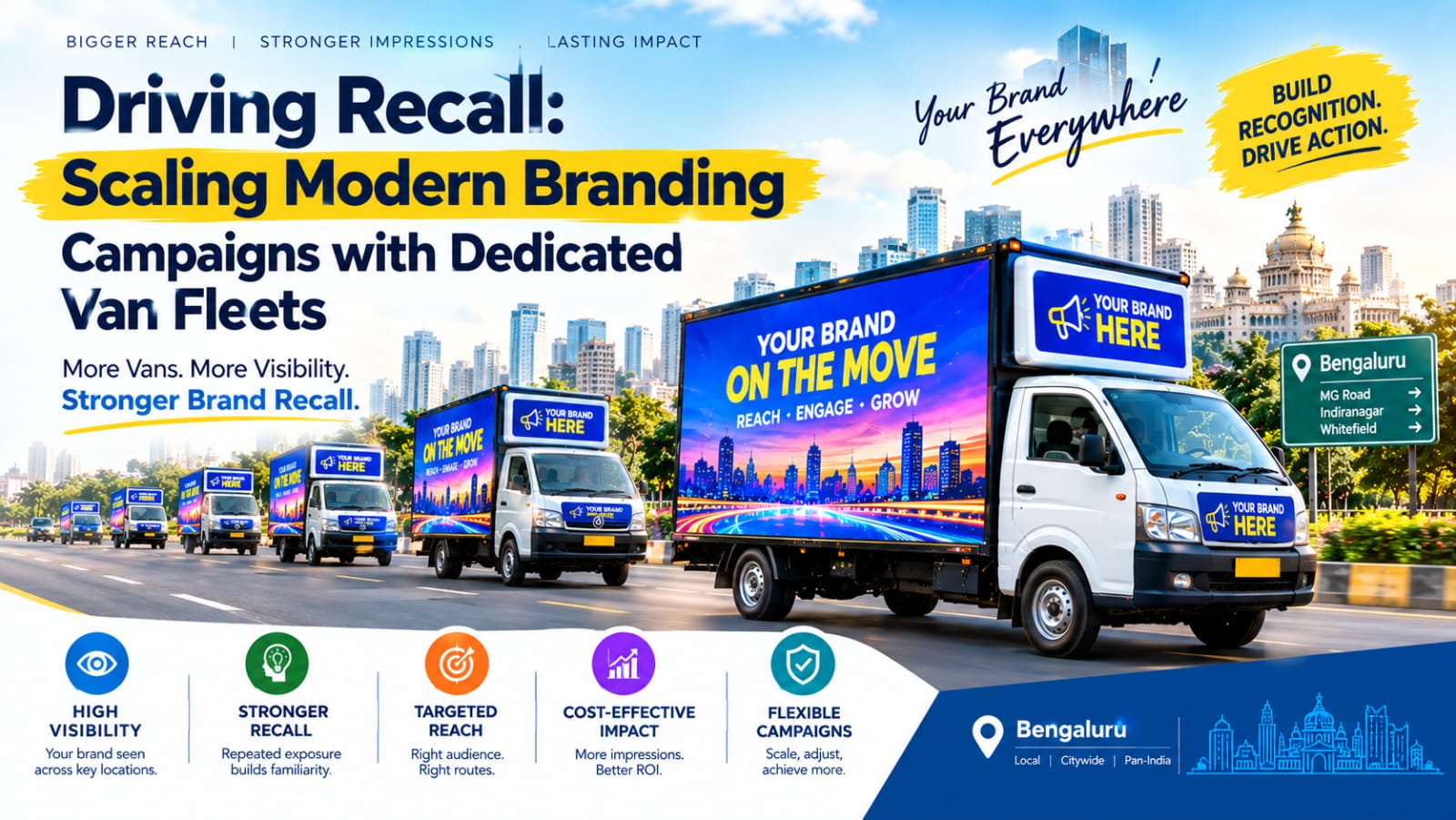
The Economics of Brand Saturation: Moving from Single Vehicles to Coordinated Fleets
Achieving sustained brand recall in a bustling metropolis requires frequency, scale, and visual dominance. While deploying a single mobile advertising vehicle serves localized neighborhood marketing well, scaling enterprise Branding—such as announcing a major brand repositioning, launching an IPO, unveiling a statewide fintech platform, or opening multiple retail outlets simultaneously—demands an orchestrated fleet strategy.
In a hyper-competitive consumer landscape, isolated impressions fade quickly. Cognitive psychology and advertising science demonstrate that a consumer must encounter a consistent brand message between five and seven times within a compressed purchase cycle to transition from passive awareness to active consideration.
Relying solely on static skyline billboards to achieve this frequency across a sprawling city is financially inefficient. Fixed billboards can cost lakhs per site per month while locking a brand into a single physical vantage point. By contrast, deploying an integrated network of mobile Van Advertising Bangalore allows brands to achieve widespread city coverage at a fraction of the cost per thousand impressions (CPM). By combining static backlit flex display vehicles with high-luminance led van advertising, marketers can saturate primary traffic corridors and residential neighborhoods with continuous, unmissable brand presence.
Fleet Topography: Designing Multi-Tier Transit Networks
Enterprise fleet branding succeeds through structured vehicle deployment. Rather than sending out identical trucks along random routes, a high-impact fleet campaign deploys specialized vehicle tiers matched to specific urban environments:
+-----------------------------------------------------------------------------+
|                 MULTI-TIER FLEET DEPLOYMENT ARCHITECTURE                    |
+-----------------------------------------------------------------------------+
|                                                                             |
|   [TIER 1: THE DIGITAL COMMAND UNITS]                                       |
|   Hardware: Heavy chassis with P4/P5 daylight LED video walls & PA audio    |
|   Target:   Commercial hubs, tech parks, key traffic intersections           |
|   Role:     High-impact sensory anchor, running video ads & product teasers |
|                                                                             |
|   [TIER 2: THE AMBIENT TRANSIT FLEET]                                       |
|   Hardware: Mid-size trucks (Tata 407 / Bolero) with backlit prism boxes     |
|   Target:   Major arterial connecting roads & commercial high streets       |
|   Role:     Continuous commuter visibility during rush hours                |
|                                                                             |
|   [TIER 3: HYPERLOCAL FEEDER VANS]                                          |
|   Hardware: Compact vehicles (Tata Ace) with 3-sided vinyl wraps            |
|   Target:   Dense residential layouts, school zones, and community markets  |
|   Role:     Street-level penetration and door-to-door neighborhood frequency|
|                                                                             |
+-----------------------------------------------------------------------------+
Tier 1: Digital Anchor Vehicles (LED Display Trucks)
These high-tech units feature high-resolution, outdoor-rated LED displays mounted on heavy chassis platforms (such as the Ashok Leyland Ecomet or BharatBenz 10-foot+ platforms). They serve as the visual centerpieces of the fleet. Stationed at prominent commercial intersections, outside major tech parks during shift changes, or near large retail malls, they deliver full-motion video, dynamic animations, and synchronized audio that stop pedestrians and motorists in their tracks.
Tier 2: The Continuous Circulation Fleet (Backlit Prism Trucks)
Medium commercial vehicles (such as the Mahindra Bolero Maxi Truck or Tata 407) carry large illuminated lightboxes on both flanks and the rear panel. These vehicles run continuous routes along primary arterial corridors—linking residential suburbs to corporate zones—ensuring high visual exposure during morning and evening rush hours.
Tier 3: Hyperlocal Penetration Vans (Wrapped Feeder Vehicles)
Compact, agile commercial vehicles (such as the Tata Ace or Maruti Super Carry) feature full exterior vinyl wraps. Their smaller footprint allows them to navigate narrow cross-streets, residential layouts, apartment complex access roads, and traditional shopping lanes that larger trucks cannot access. They provide the steady neighborhood repetition that turns broad brand awareness into local commercial action.
Fleet Convoy vs. Distributed Grid Strategies
When managing a multi-vehicle fleet, marketing teams generally choose between two core routing strategies depending on their campaign objectives:
+-----------------------------------------------------------------------------+
|               FLEET ROUTING STRATEGIES: CONVOY VS. DISTRIBUTED              |
+-----------------------------------------------------------------------------+
|                                                                             |
|   [STRATEGY A: THE HIGH-IMPACT CONVOY]                                      |
|   Vans travel together in close succession along a single corridor          |
|   ---> Visual dominance; unmissable "takeover" effect for launch events     |
|                                                                             |
|   [STRATEGY B: THE DISTRIBUTED GRID]                                        |
|   Vehicles spread independently across separate city zones simultaneously   |
|   ---> Broad municipal reach, continuous frequency, and high city coverage  |
|                                                                             |
+-----------------------------------------------------------------------------+
Strategy A: The High-Impact Convoy (“The Street Takeover”)
Execution: A convoy of 3 to 6 branded advertising vans travels together in close formation (separated by 20–30 meters) along a single high-profile corridor during peak traffic hours.
Psychological Impact: Seeing multiple branded vehicles moving in tandem creates an immediate sense of scale and importance. Consumers perceive the advertiser as an established, market-leading brand.
Best Use Cases: Movie premieres, major product reveal days, retail brand launches, and multi-store festival shopping promotions.
Strategy B: The Distributed Grid (“City-Wide Saturation”)
Execution: The fleet is divided across separate geographic zones (e.g., East Bengaluru, South Bengaluru, North Tech Corridor, and the Central Business District). Each vehicle operates independently within its assigned sector, following dedicated local circulation loops.
Psychological Impact: Residents encounter the brand repeatedly across different parts of the city—on their morning commute, near their office, and outside their neighborhood grocery market—creating the impression that the brand is everywhere.
Best Use Cases: App install campaigns, retail banking, statewide telecom launches, healthcare network expansions, and real estate portfolio awareness.
Substrate Engineering: High-Durability Materials for Fleet Longevity
Operating a fleet of mobile advertising vehicles across diverse road conditions, intense sun, and heavy monsoon rains requires high-grade materials. Substandard printing leads to faded colors, peeling vinyl, and torn seams, which actively harm brand perception.
+-----------------------------------------------------------------------------+
|             FLEET MATERIALS & SUBSTRATE SPECIFICATION MATRIX                |
+-----------------------------------------------------------------------------+
|                                                                             |
|      +---------------------------------------------------------------+      |
|      |  Exterior Wrap Vinyl: Cast PVC Media                          |      |
|      |  - 3M or Avery Dennison 80-100 micron cast vinyl film         |      |
|      |  - UV-blocking matte/gloss lamination to prevent sun-fading   |      |
|      |  - Low-shrink adhesive to prevent edge lifting over time      |      |
|      +---------------------------------------------------------------+      |
|      |  Backlit Lightbox Substrates: High-Tension Translucent Media   |      |
|      |  - 450+ GSM woven polyester flex with high tear resistance    |      |
|      |  - Light-diffusing backing layer for uniform illumination      |      |
|      |  - Non-yellowing coating to maintain color accuracy at night   |      |
|      +---------------------------------------------------------------+      |
|      |  Internal Illumination Hardware: High-Efficiency LED Modules   |      |
|      |  - IP67 waterproof injection-molded optical lens LEDs          |      |
|      |  - 6,500K pure daylight white for crisp visual reproduction   |      |
|      +---------------------------------------------------------------+      |
|                                                                             |
+-----------------------------------------------------------------------------+
Cast Vinyl vs. Standard Calendared Vinyl
For curved vehicle bodies, doors, and cabin contours, high-performance cast vinyl is essential. Unlike cheaper calendared vinyl that shrinks and cracks under intense sunlight, cast film conforms cleanly to rivets and panel curves without bubbling or lifting. Adding a UV-protective overlaminate shields the printed graphics from road grit, exhaust fumes, chemical wash soaps, and sun exposure.
Uniform Edge-to-Edge Backlighting
Poorly built backlit lightboxes suffer from visible hot spots and dark corners where tube lights fail to distribute light evenly. Modern fleets use high-efficiency, wide-angle LED modules spaced along internal reflective backing plates. This design provides clean, edge-to-edge illumination that keeps your creative legible from hundreds of meters away at night.
Command-and-Control Fleet Telematics
Managing an active fleet across a busy metropolitan landscape requires comprehensive, centralized oversight. Fleet supervisors monitor operations through an enterprise telematics dashboard that tracks daily execution across several key metrics:
| Telematics Metric | Target Standard | Operational Impact |
| Route Adherence Rate | ≥ 95% compliance with assigned daily route | Prevents route drift and guarantees contracted corridor coverage |
| Average Fleet Speed | 15 – 25 km/h in urban corridors | Ensures ad graphics remain readable to passing motorists and pedestrians |
| Display Active Uptime | 100% of contracted shift hours | Verifies that illumination systems and digital screens run continuously |
| Stationary Dwell Accuracy | 60–90 min at pre-cleared high-footfall stops | Balances moving transit coverage with high-impact static visibility |
+-----------------------------------------------------------------------------+
|                 FLEET TELEMATICS & CENTRALIZED COMMAND FLOW                 |
+-----------------------------------------------------------------------------+
|                                                                             |
|   [ON-BOARD SENSORS]                                                        |
|   - Real-time GPS Tracker (Speed, Location, Idling)                         |
|   - Screen Current Sensor (Power Draw Verification)                         |
|   - Dual-Facing Dashcams (Traffic & Visual Proof)                           |
|            |                                                                |
|            v                                                                |
|   [CELLULAR TELEMETRY LINK]                                                 |
|            |                                                                |
|            v                                                                |
|   [CENTRAL COMMAND DASHBOARD]                                               |
|   - Live Fleet Map (Shows all vehicles across Bangalore)                    |
|   - Automated Route Deviation Alerts                                        |
|   - Daily Client Verification Reports (Time-stamped photos + GPS logs)      |
|                                                                             |
+-----------------------------------------------------------------------------+
Strategic Fleet Corridors: Connecting Bengaluru’s Growth Engine
An enterprise fleet campaign must connect the city’s major commercial engines with its densest residential sectors. A balanced fleet routing plan covers three primary operational circuits:
The Tech & Business Circuit (Outer Ring Road, Bellandur, Sarjapur, Whitefield, Electronic City):
Engages high-income corporate professionals, technology workers, and commercial decision-makers during morning and evening rush hours.
The High-Density Residential Circuit (Hebbal, Sahakara Nagar, Hennur, Banashankari, HSR Layout):
Connects with multi-generational families, homeowners, and neighborhood shoppers during midday and weekend hours.
The Retail High-Street Circuit (Indiranagar 100 Feet Road, Koramangala 80 Feet Road, Jayanagar 4th Block, Commercial Street):
Reaches evening leisure shoppers, diners, and entertainment crowds under bright nighttime illumination.
Frequently Asked Questions (FAQ)
How many vehicles are typically required for an effective city-wide campaign in Bangalore?
For noticeable city-wide awareness, a minimum fleet of 4 to 8 vehicles is recommended. This allows a brand to divide the city into geographic quadrants (North, South, East, West/Central) while maintaining dedicated presence along major commuter corridors simultaneously.
Can a mixed fleet campaign run both static backlit vans and digital LED trucks together?
Yes. Blended fleets are an industry best practice. Digital LED display vehicles anchor key high-traffic commercial junctions with dynamic video, while cost-effective backlit flex vans handle continuous route circulation across surrounding arterial roadways.
What happens if an active fleet vehicle encounters a mechanical breakdown?
Full-service fleet operators maintain dedicated standby vehicles and mobile service support. In the event of a flat tire, engine issue, or display fault, a replacement unit or mechanic is dispatched immediately to minimize downtime and ensure full daily route completion.
How is fleet campaign performance reported to clients?
Clients receive daily, comprehensive telematics reports. These include time-stamped GPS route maps, total kilometers driven, average travel speeds, and time-stamped photographic proof showing the illuminated creative in high-traffic zones throughout each operating shift.