
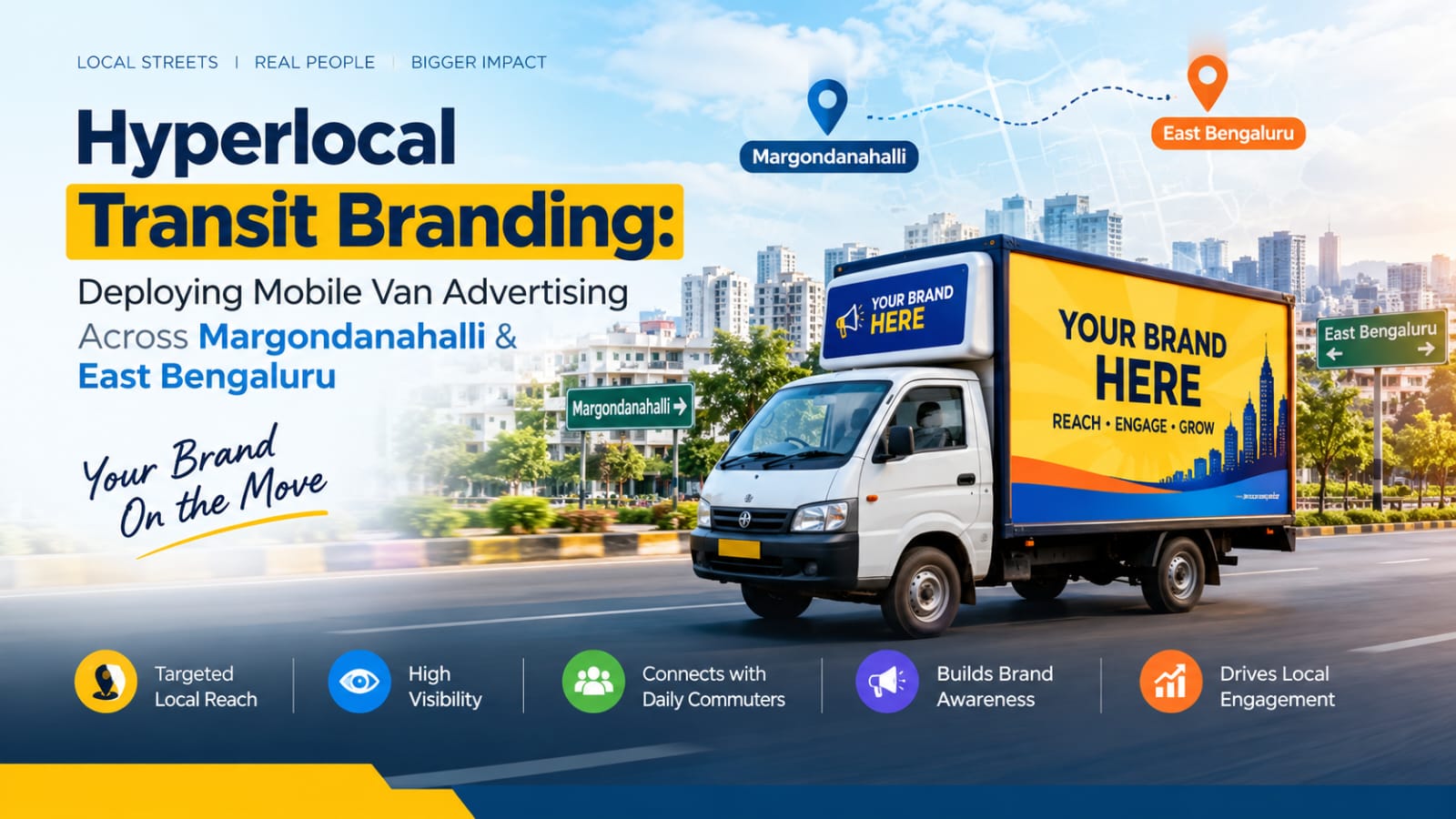
Hyperlocal Transit Branding: Deploying Mobile Van Advertising Across Margondanahalli & East Bengaluru
The Shift Toward Hyperlocal Out-of-Home Marketing in Bengaluru
Traditional out-of-home (OOH) media across Bengaluru has reached visual saturation. Elevated arterial flyovers along the Outer Ring Road, Hebbal, and Silk Board are jammed with massive static hoardings competing for fractions of a second of driver attention. For brands whose core customer acquisition funnels depend on high-density residential footfall, broad city-wide billboards lead to substantial budget leakage. When prospective buyers live within a specific 3 to 5-kilometer radius, spending budget on traffic corridors across town yields minimal returns.
This dynamic has made hyperlocal transit media the premier channel for targeted customer acquisition. Deploying mobile Van Advertising Varanasi Main Rd, Bell Town Layout, Phase II, Jinkethimmanahalli, Margondanahalli, Bengaluru, Karnataka 560036 allows retail brands, real estate developers, educational institutions, and healthcare providers to bypass static clutter. Instead of waiting for customers to drive past a fixed unipole, customized mobile advertising vans insert high-impact visual messaging directly into daily neighborhood commute patterns.
When consumers search for mobile Van Advertising near me, they need campaigns built around street-level accessibility, precise route geography, and immediate commercial recall. East Bengaluru’s mixed residential and commercial sectors present an ideal landscape for route-calibrated transit campaigns that drive sustained local impact.
Why East Bengaluru Demands Ground-Level Transit Visibility
The rapid infrastructural expansion of East Bengaluru has created thriving local economies away from the traditional central business district. Areas surrounding Margondanahalli, Ramamurthy Nagar, and KR Puram are characterized by dense residential enclaves, independent commercial high streets, and active commuter hubs.
+-----------------------------------------------------------------------------+
|               HYPERLOCAL TRANSIT CAMPAIGN: EAST BENGALURU PIN 560036        |
+-----------------------------------------------------------------------------+
|                                                                             |
|   [Margondanahalli Main Rd] ---> Residential Societies & Local Retail       |
|              |                                                              |
|              v                                                              |
|   [Varanasi Main Road] --------> Commercial High Street & Commuter Choke    |
|              |                                                              |
|              v                                                              |
|   [Bell Town Layout Phase II] -> Gated Communities & Family Catchment       |
|              |                                                              |
|              v                                                              |
|   [Jinkethimmanahalli] --------> School Zones, Clinics & Daily Footfall     |
|                                                                             |
+-----------------------------------------------------------------------------+
Static billboards face severe physical limitations in these corridors. Local street widths, municipal overhead restrictions, and dense building canopies make large overhead structures impractical or invisible to street traffic. Mobile van branding bridges this gap by positioning large-format graphics right at normal driver, cyclist, and pedestrian eye level.
Furthermore, the demographic profile across PIN 560036 consists largely of working professionals, young families, and high-frequency neighborhood shoppers. These residents spend their mornings and evenings navigating local access corridors rather than main highways. Reaching this audience requires active transit media that maneuvers through residential feeder lanes and community commercial hubs.
Strategic Route Architecture: Varanasi Main Road to Margondanahalli
A successful mobile van advertising campaign is defined by disciplined route execution. Driving randomly through suburban lanes wastes fuel and minimizes target impressions. To dominate local share of voice across East Bengaluru, routes must be split into strategic commuter phases:
Phase 1: Morning Commute Interception (8:00 AM – 11:30 AM)
During early morning hours, the primary objective is intercepting outbound traffic toward employment zones. Vehicles run continuous loops starting along Margondanahalli Main Road, feeding into the primary transit bottleneck at Varanasi Main Road. Slow vehicle movement during peak morning congestion creates extended dwell time, allowing drivers and bus passengers to read full advertising messages, product details, and phone numbers.
Phase 2: Midday Catchment & Community Visibility (11:30 AM – 4:00 PM)
As arterial traffic subsides, the campaign transitions into high-density residential layouts. The mobile van shifts into Bell Town Layout Phase II and the interior residential lanes of Jinkethimmanahalli. Vehicles operate at reduced neighborhood speeds (10–15 km/h), maximizing visibility among local residents visiting nearby grocery outlets, clinics, and neighborhood retail markets.
Phase 3: Evening Retail Rush & Static Standstills (4:30 PM – 9:00 PM)
The evening window targets returning commuters and families. Mobile vans operate along the commercial strips of Varanasi Main Road, stationing at approved, high-visibility parking junctions near prominent supermarkets and busy crossroads. Side-panel backlighting or digital displays ensure the promotional creative stays illuminated and legible well after sunset.
Operational Mechanics & Transit Fleet Engineering
Executing mobile Van Advertising Bangalore requires heavy-duty vehicle fabrication to withstand continuous street operations, uneven road conditions, and varying weather patterns.
+-----------------------------------------------------------------------------+
|                    MOBILE ADVERTISING VAN CONFIGURATION                     |
+-----------------------------------------------------------------------------+
|                                                                             |
|      +---------------------------------------------------------------+      |
|      |  High-Tension Vinyl Wrap / Backlit Flex Display Box           |      |
|      |  (Dimensions: 10ft x 6ft Side Panels | 6ft x 6ft Rear Panel)   |      |
|      +---------------------------------------------------------------+      |
|      |  Chassis: Tata Ace / Mahindra Bolero Maxi Truck               |      |
|      |  Power Source: In-Cab Secondary Battery / Silent Genset       |      |
|      |  Monitoring: AIS-140 Certified GPS Telematics Unit            |      |
|      +---------------------------------------------------------------+      |
|                                                                             |
+-----------------------------------------------------------------------------+
Display Formats: Backlit Flex Boxes vs. Daylight Vinyl
Backlit Prism Boxes: Fabricated using structural steel frames and high-translucency flex sheets illuminated by interior LED arrays. Backlit setups provide uniform luminosity without dark spots, making them ideal for high-traffic evening campaigns.
Full Exterior Wraps: Direct vehicle branding using cast vinyl with anti-glare, UV-laminated protection. This covers side panels, the rear face, and cabin contours, transforming the entire truck into an eye-catching brand statement.
Verified Fleet Telematics
Every modern transit vehicle must carry an active GPS tracker synced to a centralized dashboard. Campaign managers track daily route compliance, total distance covered (typically 40 to 80 km per day), average travel speeds, and verified stationary dwell times along Varanasi Main Road. This telematics data provides brands with transparent daily reporting.
Measuring Hyperlocal ROI: Tracking Inquiries from Transit Campaigns
The primary critique of traditional out-of-home advertising has historically been the difficulty in tracking conversions. However, modern local transit campaigns use several direct-response mechanisms to track inquiries accurately:
| Conversion Channel | Implementation Method | Primary Advantage |
| Dynamic QR Codes | Large high-contrast QR codes placed at pedestrian eye level on side and rear panels. | Instant redirection to WhatsApp booking lines, landing pages, or store directions. |
| Dedicated Vanity Numbers | Clean, memorable local telephone numbers displayed exclusively on the vehicle body. | Direct attribution of all incoming inbound calls to the active transit campaign. |
| Localized Promo Codes | Prominent discount vouchers (e.g., VARANASI20 or MARGON50) featured on the creative. | Clear purchase tracking at physical billing registers and local POS terminals. |
By pairing these tracking mechanisms with targeted route circulation, regional business managers can calculate accurate Cost Per Acquisition (CPA) metrics that rival traditional digital performance marketing channels.
Regulatory Clearances, Permits, and BBMP Compliance
Running street advertising in Bengaluru requires careful adherence to local regulatory frameworks to prevent campaign disruptions or vehicle impoundment. Key legal prerequisites include:
Bruhat Bengaluru Mahanagara Palike (BBMP) Clearances: Verification of municipal transit advertising guidelines and commercial display permissions across public corridors.
Regional Transport Office (RTO) Endorsement: Ensuring vehicles are registered as commercial transport assets with authorized commercial livery permits.
Traffic Police Approvals: Route planning that respects no-halting stretches, school zone silence requirements, and peak-hour vehicle dimension restrictions along Varanasi Main Road.
Full-service transit marketing agencies manage these approvals beforehand, protecting the client’s brand reputation and ensuring smooth, continuous daily execution.
Frequently Asked Questions (FAQ)
What daily distance does an advertising van cover in a targeted neighborhood campaign?
A standard neighborhood transit campaign covers between 40 km and 70 km per 8-hour shift. Speeds are deliberately kept low (under 25 km/h) to maintain high visual legibility across local shopping lanes and residential layouts.
Can the van remain stationary at high-traffic intersections?
Yes. Campaigns can be configured for a mix of moving transit coverage and approved static positioning. During peak retail hours, vans can park at high-footfall intersections, community markets, and near apartment cluster gates along Varanasi Main Road, provided local parking rules are observed.
How quickly can a mobile van advertising campaign launch in Margondanahalli?
From the moment creative artwork is finalized, structural flex printing, frame mounting, and RTO route alignment typically take 48 to 72 hours. Campaigns can launch within 3 to 4 business days.